
Most people assume that promotions go to whoever works hardest or performs best. In most organisations, that is not quite how it works.
What actually determines who moves up, and how fast, is something far less talked about: executive presence.
It is the quality that makes decision-makers see you as ready for the next level, often before you have formally proven it.
And according to research by Coqual, it accounts for 26% of what it takes to reach senior leadership.
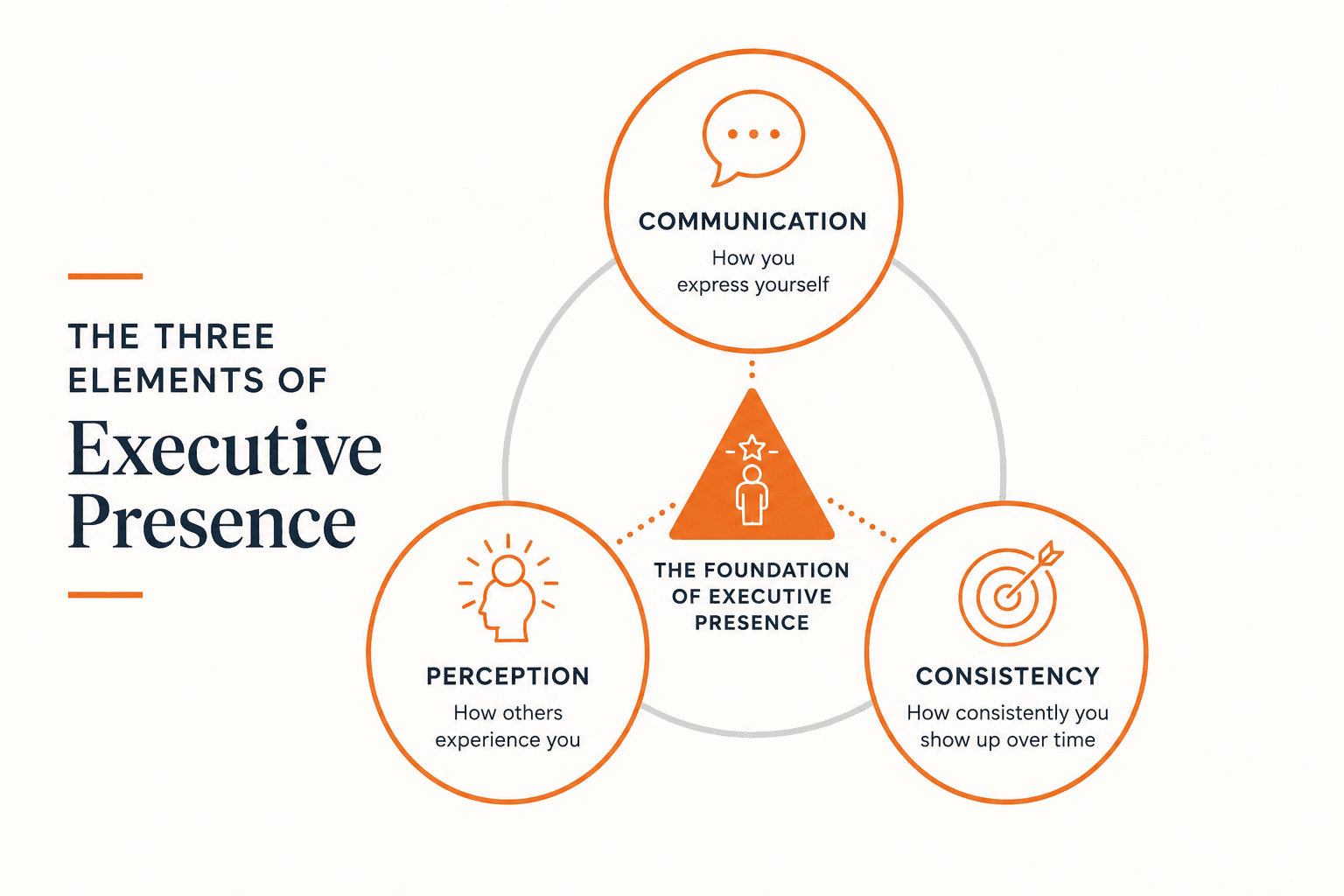
In simple terms: executive presence is the combination of how you communicate, how you are perceived, and how consistently you show up under pressure, working together to signal that you belong at the next level.
I have spent over a decade coaching C-suite professionals and senior leaders across the UK and beyond.
In that time, I have seen brilliant people get passed over; not because they lacked ability, but because the room could not see it.
This article explains what executive presence actually is, why it shapes careers more than most people realise, and how you can start building it, wherever you are right now.
In this article
1. What executive presence actually means
2. Why it determines who gets promoted — not just who deserves it
3. The 3 core elements of executive presence
4. What it looks like in practice — a real example
5. How to start developing executive presence at work
6. Frequently asked questions
What executive presence actually means — and what it does not
Let us start with what executive presence is not, because the misconceptions are everywhere.
- It is not confidence, though confidence plays a role.
- It is not the loudest voice in the room, the most expensive suit, or the longest list of qualifications.
Executive presence is the ability to communicate your competence and authority so clearly, through how you speak, how you carry yourself, and how you show up, that the right people take you seriously before you have made your case.
Executive presence is the ability to communicate your competence and authority so clearly, through how you speak, how you carry yourself, and how you show up, that the right people take you seriously before you have said a single word.
Two managers walk into a board meeting. Both have the same experience. Both have prepared equally well.
One commands the room the moment they sit down. The other, just as talented, is talked over, overlooked, and later passed over for a promotion that should have been theirs.
GET A COPY OF MY NEWEST BOOK - Move from undervalued to highly paid in your field
Research note
A 2012 study by the Centre for Talent Innovation (now Coqual) found that executive presence accounts for 26% of what it takes to get promoted into senior leadership — making it the second most important factor after 'pillar of the organisation'.
Why executive presence determines who gets promoted — not just who deserves it
This is the part most organisations will never put in writing. Promotions are not purely merit-based. They are perception-based.
When a leadership team sits down to decide who moves up, they are not reviewing spreadsheets of output. They are asking one question, often without saying it out loud:
————————————
Does this person look, feel, and communicate like someone who belongs at the next level?
————————————
Sarah is a senior finance director at a consulting firm in London. Her numbers are consistently the best on the team. She works longer hours than anyone. Her manager tells her she is doing brilliantly.
She has been passed over for promotion three times in four years.
When I worked with Sarah, the issue became clear within the first session. Sarah's executive presence; how she showed up in meetings, how she communicated her ideas, how she held herself under pressure, did not match her actual capability.
The gap between her competence and her presence was costing her the career she had earned.
Within 90 days, Sarah had been put forward for promotion. Not because she suddenly became smarter. Because the right people could finally see what she was worth.
Same qualification level — two different outcomes
High competence + low executive presence:
- Gets the work done — rarely gets the credit.
- Talked over in meetings despite being right.
- Promoted slower than less-qualified peers.
- Described as 'not quite ready yet.'
High competence + strong executive presence:
- Gets the work done — and gets noticed for it.
- Commands the room with calm authority.
- Moves into leadership ahead of schedule.
- Described as 'exactly what we need at that level.'
The 3 core elements of executive presence
Executive presence is not one thing. It is three things working together.
1. COMMUNICATION. Not just what you say, but how you say it
Executive presence in communication is about speaking with authority, not volume.
It is the ability to make your point clearly in a room full of noise. To give feedback without apologising for it. To disagree with a senior leader without backing down or becoming aggressive.
Marcus, a VP at a financial services firm in Manchester, described it this way after working with me:
2. PERCEPTION. How others experience you before you speak
This is the element most people resist.
Your visual presence, how you dress, how you enter a room, how you sit, communicate something before you open your mouth.
Researchers at Princeton found that people form first impressions in as little as one-tenth of a second. That impression sticks.
This is not about being flashy or spending money on designer clothes. It is about strategic alignment: making sure what people see when they look at you matches what you want them to believe about your capability.
For executives in conservative sectors like banking, law, or government, this often means understanding the unspoken dress codes of power in their industry and using them deliberately.
3. CONSISTENCY. Showing up the same way whether the stakes are low or high
This is the element that separates good performers from genuine leaders.
Anyone can show up well on their best day. Executive presence means showing up well under pressure, in difficult conversations, when the news is bad, when the room is hostile.
Consistency is what makes people feel safe enough to follow you.
What executive presence looks like in practice
Amara is a director at a healthcare organisation in Birmingham. She came to me after being told, twice, that she 'was not quite ready' for the next level.
She had a postgraduate degree, 12 years of experience, and a team that respected her deeply.
In our first session, I noticed three things immediately:
- Amara minimised her own contributions when speaking to senior stakeholders, with phrases like 'this might be a silly idea, but...' before sharing genuinely strong ideas
- Her wardrobe, while professional, did not signal the seniority of the role she was targeting
- In high-stakes meetings, she became quieter, not louder, which read as uncertainty rather than thoughtfulness.
Over 90 days, we worked on all three. Amara was promoted within six months of completing the programme.
She did not get smarter. She did not get more experience. She got visible.
If this sounds familiar, the experience is there but the visibility is not, my coaching programmes are designed exactly for this.
Explore executive presence coaching →

How to start developing executive presence at work — 4 steps
You can begin developing executive presence without professional support.
What you need first is awareness, the ability to see yourself as others see you, and the intention to change what you find.
Step 1 — Audit how you show up in meetings
For the next two weeks, notice one thing: when do you make yourself smaller?
- Do you over-qualify your ideas before sharing them?
- Do you wait to be invited to speak?
- Do you sit on the edge of the room rather than at the table?
Executive presence at work starts with visibility. If you are not being seen, you cannot be promoted.
Step 2 — Lead with your conclusion
Most professionals bury their main point under context, caveats, and background.
Senior leaders do the opposite. They state the conclusion first, then provide supporting detail only if asked.
Next time you are in a meeting or writing an email, try this: state your recommendation in the first sentence. Watch how differently people respond.
Step 3 — Align your visual presence with the role you are targeting — not the one you have
Dress for the role you are targeting, not the one you currently hold. This is timeless advice, and it works, not because it sounds clever but because perception is real and decision-makers are human.
This does not mean spending money you do not have. It means being intentional.
- Research what the people one level above you are wearing.
- Notice the unspoken visual language of your industry.
- Make deliberate choices.
Step 4 — Find one high-stakes situation every month and stay present in it
Consistency is built through repetition. Pick one situation each month that would normally make you shrink: a difficult conversation, a presentation to senior leadership, a negotiation and commit to showing up fully in it.
Executive presence is not a personality trait. It is a skill, and skills are built through practice.
Want a structured path instead of trial and error?
My 30-Day Impact Transformation combines presence coaching, LinkedIn optimisation, and wardrobe strategy into one focused programme. Most clients notice a measurable shift within the first two weeks.
Ready to close the gap between your competence and how you are perceived?
Book your free 30-minute discovery call →

Frequently Asked Questions About Executive Presence
I. Can executive presence be learned, or is it something you are born with?
It can absolutely be learned. Executive presence is a set of skills: communication, self-awareness, strategic visibility; not a personality type.
I have coached over 170 C-suite professionals across the UK and internationally, the vast majority of whom came in feeling invisible and left with a measurable shift in how they were perceived.
It takes intention and practice, not a particular personality.
II. How long does it take to develop executive presence?
Most of my clients notice a shift in how they are received within the first 30 days, particularly in how they communicate and how they show up in meetings.
Deeper changes; promotions, salary increases, being sought out for high-profile projects — typically show up within 60 to 90 days of consistent work.
The timeline depends on where you are starting from and how much you commit to applying what you learn.
III. What is the difference between confidence and executive presence?
Confidence is internal: it is how you feel about yourself. Executive presence is external: it is how others experience you.
You can feel completely confident and still have low executive presence if that confidence is not translating into how you communicate, how you hold yourself, and how you show up in high-stakes situations.
The goal is to close that gap, so that what you feel on the inside matches what others see on the outside.